
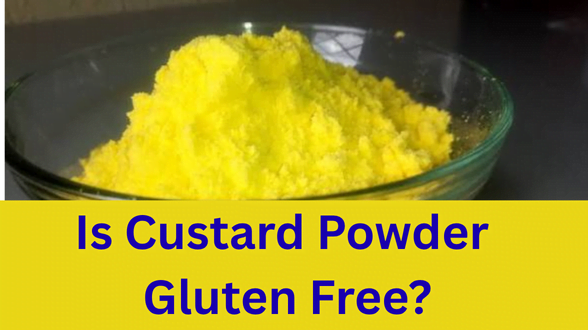
Custard isn’t getting enough hype. Cooked, baked, thin or thick… You can never go wrong with it. It is delicious when served on its own, as a base for other creamy desserts, or as a filling.
However, being coeliac means I experience a little difficulty when sourcing the right powder to stock up at home. And I know you may be facing the same difficulty.
You may love your own custard powder from scratch, but more often than not, it’s more convenient to pick it up from the corner shop. So what should you keep in mind when sourcing your next gluten-free custard powder?
Is Custard Powder Gluten Free?
Custard powder can be gluten-free, but this varies by brand. Custard powder commonly uses maize starch (cornflour) as a thickener instead of wheat flour.
Some brands may use wheat starch, add other ingredients that may contain wheat, or use processes that could lead to cross-contamination during production.
A typical custard powder contains salt, cornflour, food colouring, and flavourings which are typically gluten-free.
However, adding some other signature ingredients that may give the company a distinctive taste or mouthfeel, or using a shared production line with products made with wheat, could introduce gluten to the custard powder, like some brands we will discuss later in this article.
Is Custard Powder Gluten Free In Australia
To meet the no-detectable-gluten standard in Australia or New Zealand, a product must meet the applicable requirements for gluten-free claims. Laboratory testing with a limit of detection (LOD) of around 1–3 ppm can help verify compliance. (Coeliac AU).
Furthermore, companies voluntarily use statements like “may contain traces of gluten”. In some cases, the absence of these voluntary warnings does not, by itself, establish that a product meets the gluten-free standard.
This led me to research product information and reach out to some of the companies that make these custard powders to gain a clearer understanding. Here is what I have found:
Nurses Custard Powder
Nurses’ custard powder (with the signature yellow package) is not gluten-free. Its primary ingredients are wheaten starch, salt, flavour, and colour. This should be off your list if you’re on a gluten-free diet, unless they reintroduce a gluten-free line in the future.
Coles Custard Powder
Standard Coles’ custard powder is not gluten-free. It contains sugar, vanilla flavour, salt, natural colour, and wheat starch.
I came across references to Coles’ gluten-free custard powder, introduced around 2018; however, it appears that it may have been discontinued, as I couldn’t find it in stock at Coles or Woolworths.
Moir’s Custard Powder
Unlike most other products on this list, Moir’s Custard Powder is made with cornflour or tapioca starch instead of wheat. However, it is not specifically labelled as “gluten-free”! I tried to contact the manufacturer, Pioneer Foods (Pty) Ltd, but its website is down, and they haven’t replied to my LinkedIn messages.
Foster Clark’s Custard Powder
Foster Clark’s standard 350 g box of custard powder is not gluten-free. This product is formulated with both wheat and maize starch.
The Foster Clark’s Seriously Creamy Egg Custard Powder Mix may also be unsuitable for people with coeliac disease, as it carries the “may contain traces of gluten” warning.
Is Custard Powder Gluten Free in the UK
In the UK, 20 mg/kg is the allowed limit for a gluten-free claim. UK food labelling requires that any of the 14 allergens present in a product should be bolded, capitalised, or underlined in the ingredients section.
This makes it easier to identify gluten-containing products. However, the clearest indication that a product is gluten-free is if it’s labelled as such.
Birds Custard Powder
Bird’s confirms on its website that its listed recipe doesn’t contain gluten-containing ingredients, which is reassuring when using this custard in my desserts.
However, Bird’s can’t label its custard powder as gluten-free because of its current manufacturing processes and operations. The company also mentions integrated efforts to limit cross-contamination.
Aunt Bessie’s Custard Powder
Aunty Bessie’s Custard is not explicitly labelled as gluten-free.
It appears to have no obvious gluten-containing ingredients. However, my coeliac intuition raises an eyebrow at the modified starch it uses.
Modified starch can be derived from pretty much anywhere: corn, wheat, tapioca, etc. I have confirmed the modified starch in this product to be maize starch.
James Brown & Co. Custard Powder
It is gluten-free based on its ingredients. However, it doesn’t have an explicit gluten-free certification.
Explicitly Gluten Free Custard Powders
The following custard powders may not be in stock all year round, but if in stock, they are labelled ‘gluten-free and suitable for coeliacs’:
- Just Wholefoods Vanilla Custard Powder
- Orgran Instant Custard Mix
- Well & Good Vanilla Custard Powder
- Pure Gluten-Free Custard Powder
A typical concern my friends bring up each time I recommend either of these custards is the flavour and how they thicken up.
These gluten-free custard powders sometimes use the same ingredients as your traditional custard powders. The only difference is that the manufacturers are more intentional about limiting gluten contamination.
In other cases, they could use rice flour, potato starch, or other ingredients which may slightly impact the outcome. Bear this in mind.
Is Ready-Made Custard Gluten Free?
Some ready-made custards are suitable for coeliacs, as they don’t contain gluten-containing ingredients, but this can vary based on individual products. Go through the ingredients and rule out possible allergen inclusion before purchasing.
If you’re looking for brands with a clear gluten-free label, then you should lay your hands on the following:
- Alpro Vanilla Soya Dairy Free Alternative to Custard
- KoalaKoi Ready to Serve Custard
- Ambrosia Devon custard
Final thoughts
Custard powder made with ingredients such as cornflour, rice flour, or tapioca instead of wheat flour can be gluten-free.
However, before deciding which custard powder to stock up on, read the ingredients for possible allergens and check for “may contain traces of gluten” warnings.
You should also be aware that some products without an explicit gluten-free claim may not contain gluten, but the manufacturer has not carried out the analytical testing required to confirm the product’s gluten-free status.
